Wednesday, May 5, 2010

No newspaper, No News

In my Art History class this semester, part of our assignment was to read the New York Times everyday. We would then be randomly quizzed on our knowledge of the current events displayed in the newspaper. I found this at first to be completely irrelevant of Art History, and also, simply unnecessary. However, as I was forced to read the New York Times due to the sake of my grades, I found that I actually enjoyed the reading, and also felt well-informed of the news.

Having just finished my final English paper on the impact of the Internet in political journalism, I learned much about the transforming media. Because of the birth of political blogs and websites, a significantly less number of Americans today use traditional media sources, such as newspapers, magazines, and broadcasting.
Though the Internet would seem to benefit American general education in its convenience and availability, it consequently allows for inaccuracy, decreased focus on political policy, and dangerous partisan division. Unlike this lack of credibility, mainstream media emphasizes heavy editing and concealment of any bias which might inhibit the reader's ability to form opinions of his own.

Though it may be more time-consuming to sit down and sift through the articles of a newspaper, more people would probably have a clue about what is going on in the world today. Not only is it important to remain informed, but a lacking state of public knowledge impairs our society and government. People need to be fully informed of present events, influences, and occurrences, as they effect not only the nation in which we reside, but also our own lives.


The Loss of Love

Only a few days ago, a fourth-year student at the University of Virginia was murdered. She was not killed by some mentally insane psychopath or serial killer, but instead, was strangled by her own drunk boyfriend. The morning on which Yeardly was found dead, the police immediately went to her boyfriend. George Huguely was still asleep, however, and did not have much recollection of the previous night, due to his heavy partake in binge drinking. Although he was not in a clear state of mind, Huguely's actions remain, in that he drunkenly beat and strangled his girlfriend.

As one of my friends attends the University of Virginia, she called me to share with my this tragic and horrifying story. The fellow students, friends, and family of Yeardley Love are all in utter disbelief not only have they lost their loved one, but also how it happened, as alcohol managed to create a killer.

In the story of Yeardley Love, the extreme effects of alcohol is apparent. Though college campuses do reiterate the ways to safely drink alcohol and abstain from binge drinking, people often forget that it even alcohol poisoning is not the only thing that can be dangerous. Alcohol effects a person's judgment and behavior, and as proven at UVA, can completely change a person's actions.

College students today, take an attitude that is often too casual when it comes to binge drinking and alcohol abuse. They think that it is simply a way to have fun and conform to the college "partying" age. Students need to be encouraged to abstain from binge drinking not only for the sake of their safety, but also for the safety of others, in order to avoid dangerous and tragic results, such as the painful loss of Yeardley Love.


Freedom of Anti-American Speech?

Many people today think that the days of the violent hate groups are over since the civil rights resolutions in the 1960s. However, my roommate recently showed this to be far from the facts. A current group that refers to themselves as the Westboro Baptist Church, has created a notorious fame of publicly displaying their prejudices against homosexuality.

The members of this "religion," exhibit their hatred for homosexuals in quite the public manner. With their website titled "God Hates Fags," the Westboro Baptist Church has tried to spread their message to the public. The groups ideology conveys that through tragic events such as September 11th, the killing in combat, and the increase of diseases like AIDS, God is trying to send a message: to terminate homosexuality. Members of the group frequently attend the funerals of American soldiers, in order to reiterate their beliefs that God killed this soldier as punishment for the American army's allowance of gays.

The hate organization also condemns those of the Jewish, Catholic, and some Protestant faiths, professing that Hitler had it right during the Holocaust. The WBC finds that these religions are almost as low as the homosexuals in the mind of God. Unlike these faiths, the WBC believes the sinful nature of American acceptance of diversity to be the central principal.

Upon my initial discovery of this current hatred, I was in complete disbelief. Irrelevant to whether people morally support homosexuality or not, there are no exceptions to this behavior. As lawsuits have been filed against the Westboro Baptist Church, the WBC has legally prevailed, arguing their American right to free speech. However, as this behavior is contradictorily Anti-American, shouldn't their be some type of legal justice?


Friday, April 2, 2010

Facebook Stalking

Recently I found myself having a conversation with a friend after coming back from spring break. While she was telling me all about her vacation, I realized that I creepily already knew all about where she had been due to pictures on Facebook. The more I thought about this, the more I realized how creepy Facebook actually is.

Whether it is wall posts, pictures, or other Facebook applications, our possession of Facebook accounts does indeed take a lot away from our right to privacy. When we upload our latest photo albums publicly displaying where we have been and whom we have been with, it allows basically anyone on the Internet to have intense insight into our lives. Though we can set our privacy settings, Facebook ultimately has ownership over everything we post to it.

While we sometimes may not realize it, when we post pictures or comments on Facebook, we have control over who maybe seeing it. This may not initially seem like a problem, but this has currently developed into a serious issue in the professional world. Now, when we are applying for jobs or scheduling interviews, companies and employers frequently browse Facebook first. When inappropriate pictures or posts bombard potential employees Facebook pages, employers now wave this as an automatic red-flag.

Though it may in some ways infrine on personal privacy, Facebook provides many benefits. It is an awesome way of communication and sharing, but we must remember to take caution in what we display, as is open for all eyes to see.

Internet Diagnosing

As we begin to choose topics for our next English paper, I found the idea of the Internet and its effect on health a particularly interesting subject that had not crossed my mind before. Though doctor visits and check-ups are always important to our health, now it is much easier to research symptoms, browse through treatments, and even diagnose ourselves with the help of the net.

Websites such as WebMD, provide thorough and quality information of all health issues from the common cold to cancer. One can compare symptoms or medicines and create fairly accurate predictions about one’s own health through this wealth of medical information.

In the past, whenever people have stuffy noses or stomachaches, people would run to the doctor. But now, we can simply click a few buttons and find that there is actually no need for emergency care, which in return may help the crowded waiting rooms of the doctor’s office. It also may help detect signs of serious illnesses earlier, when finding that medical treatment should be sought. Who knew the Internet could be our new medical aid?

Sunday, February 28, 2010

Fighting At Five?

Throughout the year, I have been working with a ministry in Dallas, helping to tutor and mentor children of families which are less fortunate. I help them with homework, play games with them, and have also helped serve food at snack time. One particular time really struck my attention however.

After snack time, the group of kindergardeners came back to the class room and were very riled up and hyper. They were constantly provoking one another. Not only were the kids especially irritable and aggressive, but also the teacher was absent much of the time and I was left responsible to watch out for the group. All of the sudden two boys, only at the age of five, started to punch each other and yell, while the rest of the class gathered around them, cheering "fight! Fight! Fight!" Since the teacher was still missing, I had to step in and break up the argument.

I have never had to actually intervene and physically pull boys apart from one another during a fight and I don’t really think that as a 19-year-old girl volunteer, the teacher should have left such activities left to me, but it was an interesting experience. It made me feel uncomfortable that kids at only the age of five were already fighting and throwing punches at one another, while the other classmates chanted as if this were normal behavior. This was somewhat disturbing to me, because when children are developing habits like this at such a young age, their future of developing aggressive habits is inevitable.

Yet, we wonder why there is so much violence and crime. If behavior like this is rooted in children at such a young age and fist fights are a normal kindergarten occurrence, I think we need to be taking a little more time and energy on early childhood education, as that is where children learn their habits.

Mornings at Mac's

We've all heard it. Breakfast is the most important meal of the day. Though I myself am a huge breakfast eater and never go a day without it, many people, especially teenagers, tend to skip breakfast in exchange for a few more last minutes of shut-eye. However, studies have shown that those who consume the nutrition benefits from breakfast do better in school. With the intake of vitamins and protein from breakfast, students have more energy and concentration in class.

Therefore, as a freshman college student, as well as a frequent customer at Mac's Place, I think that Mac's Place should offer the option of breakfast to students. It stays open every night until midnight, but it doesn't open until 11 A.M. everyday. Since college students like to sleep as much as possible, and since three dorms are all very close to Mac's Place in location, I think more students would eat breakfast if it were offered close by. Why not close a few hours earlier at night time in order to open a few hours earlier if it will enhance our learning? I think it is definitely worth it.

Monday, February 1, 2010

Introduction to Grown Up Digital

As Don Tapscott introduces his views on today's Net Generation, he begins with the interesting inclusion of his children's early employment of the internet to engage readers in the new era of the World Wide Web. Observing his children's exquisite ability to use the internet, Tapscott was inspired to further his knowledge of this growing culture, as he founded nGenera to study the effect of the web on the world.
Researching the characteristics and various types of new technology, Tapscott concludes that now this "Net Generation has come of age," implementing life with the web throughout the world. As many criticisms, such as the loss of social skills or a lacking work ethic, are instilled upon such a culture founded on technological advances, nGenera conducts thorough research on the life of the Net Generation to prove the worth of the Internet. As older generations remain nervous of the new and unknown, hostility to the younger prevails, frequently displaying the cons of this new lifestyle.
Tapscott argues the way of life led by the Net Generation to be one of advancement and positivity. In agreement as a member of the Net Generation, I believe that the internet has changed all of our lives for the better. Contrary to some of the older generation's beliefs, I have not lost my social skills, but enhanced them through new methods of communication such as Skype and Facebook. I have a stronger work ethic as I am now accessible to such an immense amount of resources at my fingertips. Without the internet, all of our lives would be very different.

Monday, January 25, 2010

Gone with Gossip

Recently, I was informed of a newly popular website called CollegeACB. On this website, anonymous writers will post gossip about specific people, groups, or other miscellaneous campus occurrences. After the initial post, other anonymous writers can contribute to the online slander with their own comments. With the anonymity prescribed by the Internet, people do not refrain from displaying their true thoughts, as there is no fear of exposure. Consequently, with this lack of censorship, people do not stop from writing extremely inappropriate and unkind comments.

This trend not only has the potential to offend people, but it also leads to a lot of misinformation. As anyone with Internet, which the majority of college students have, can go online and read these comments, there is no evidence supporting that what is discussed is true. This introduces a whole new way of inventing rumors, just what college students do not need.

Many of my peers and fellow students enjoy reading what CollegeACB has to say, finding entertainment in the ridiculous statements people post to this website. However, I believe that anonymous posts are what feed this website, and therefore, students should not even access this site. It is unbelievably inappropriate and inhumane for students or groups to be associated with false rumors, or be discussed publicly. The cruel students who post these things to CollegeACB are just provoking other students to follow. The only way to bring an end to their writing is to just simply stop reading.

Friday, December 11, 2009

Revision of Personal Experience

After a bumpy flight filled with my anxieties of the unexpected, my over-packed suitcase and I piled onto a bus and began to drive through the beautiful countryside. I had woken up that morning in the comfort of my own home, and now was anxiously anticipating what was to come as I began my mission trip to El Salvador. I had imagined the country of El Salvador to be dry and desolate filled with nothing but stray animals and littered trash. However, whether I liked it or not, I was now rolling along the curvy roads of El Salvador where I would be working to build a high school for the next week. Looking out the window at the miles of nothing but green pastures and beautiful mountains, I decided maybe this place was not so bad after all. “We are here!” As our 18-passenger bus with its folding seats trudged up the unpaved hills of El Salvador, my attitude from earlier that morning began its 180-degree turn.

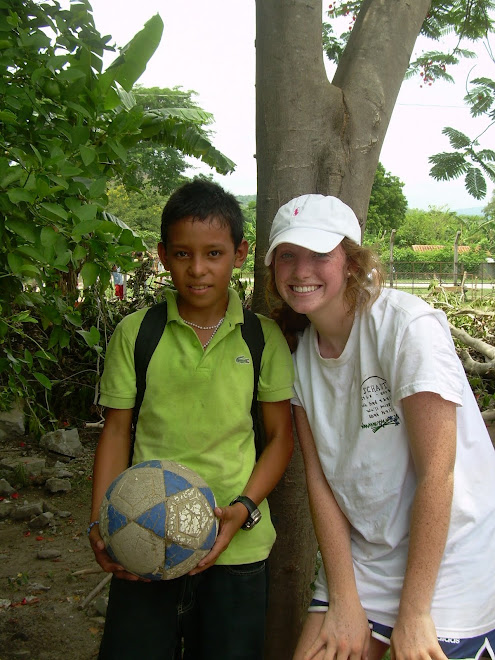
On my first day of work in the small town of Copapayo, El Salvador, I encountered a multitude of kind and welcoming faces. However, one in particular caught my attention. His name was Alexei. Alexei came to school everyday dressed in the same clothes as the day before, and the same broken sandals to attempt to protect his feet. Alexei and I first connected on the soccer field as we worked together as teammates to score on a goal made from two pieces of trash. We spent hours passing the soccer ball back and forth, dancing to Latino music, and eating tortillas quickly building a strong foundation of friendship. Of course our conversation consisted of no more than my few butchered attempts to say "Hola! Como estas?" followed by his returned looks of confusion and laughter, yet we still developed a tie of genuine bond.


On our last day of work in El Salvador, I said a sad good-bye to Alexei after the party we threw for the students at the school in Copapayo. About ten minutes later, I saw a familiar face wandering back to the worksite. It was Alexei again. After making friendship bracelets for one another out of some old yarn, we said a second round of farewells and parted ways. Yet after another hour, as our group began to board the bus to leave Copapayo, I looked up one last time. Alexei stood standing on that same soccer field where we had first met. Running up to me and planting a kiss on my cheek, he and I shared a tearful last "adios," for the third and final time. This bond between Alexei and me was a tie that would last forever. Though I knew I would never see his face again, he impacted me in many ways, and taught me the value of life comes not from material wealth, but from relationships and personal experiences.

As I arrived back at home the next week, I no longer found myself dwelling on the comforts of my own home as I had done early that morning of my departure, but instead found myself looking at those "comforts" of my own life with new eyes. Compared to the cardboard boxes I had seen families like Alexei's live in, my own house was a mansion. To their three daily tortillas, our refrigerator was overflowing. Coming back that third time to say good-bye, Alexei was my reminder of what genuine happiness looks like. Though Alexei and I were faced with cultural, lingual, and economic barriers, his passion and love of life inspired me to live a more wholesome life such as his. While I was a 16 year old girl with a closet full of shoes and a drawer full of shorts, this nine-year-old boy, with holes in his shoes and a single pair of shorts to wear for his every day, was never seen without a smile on his face, illuminating life's light.

In our world today, we are held to a certain standard of perfection, in which it is easy to forget the element of truth and substance in life. Embedded into the heart of the American consumer based society, we are told what clothes to wear, what food to eat, and how we should live, assuming the attainment of these things will result in happiness. In an endless chase for achievement and success, we find ourselves entangled in the materialistic web spun by society's spider, having lost sight of life's true meaning. Can we even begin to fathom life as Alexei, with hardly any money, a single outfit, and the same food everyday, and at the same time imagine happiness? After my cultural exchange and witness in Alexei, I found my eyes had been reopened to a new perspective on life.

Wednesday, December 9, 2009

Setting an Example

On November 27, a little over a week ago, Tiger Woods’ Escalade was found crashed in the middle of the night. It was later unveiled that he has multiple mistresses, and his wife had been using his own golf clubs violently against him hitting his car.

As Hollywood celebrities tend to frequently make bad impressions of themselves by their actions and poor decisions, it is always more frustrating to me to see professional athletes fall under this category. People all over the world, especially children and aspiring young adults, look to athletes as role models. Of course everyone sees celebrities as stunning and fascinating, but people find athletes to be inspirational and hard-working, as many times these athletes have come so far to stand where they are today. When outstanding Olympic Gold Medalist swimmer Michael Phelps was publicly displayed smoking marijuana, it ruined this image of a driven and unwavering young man, who put everything into his career, as most people saw him.

These athletes such as Tiger Woods and Michael Phelps are obviously famous worldwide. In their performance and lifestyle, they know that with fame comes publicity, as well as responsibility. Thousands of people look to them as powerful examples in life, yet they lead lives with drugs and sex scandals, and therefore ruin their reputations. It is an honor to achieve such a high recognition in life, and an honor to be admired so immensely. Therefore I think that professional athletes should be much more careful about the decisions they make and the lives they lead, as they are providing examples to so many.

Monday, November 30, 2009

Laptops or Paper?

“Mom, I want to switch schools,” I said one day after coming home with news that our sister school would be implementing a new personal laptop program for its students. At my school, we had many computer labs and portable carts in classrooms with the newest version of the Apple laptop, but that was not enough. I wanted to take one home with me and have one with me at all times, and now that some of my friends at our rival school would have them, I was very bitter towards my own school.

However, that next year as my friends from the neighboring school began their new program in which math problems and note taking were all completely on a Dell notebook, they all also began to spend much time waiting in the school’s technology office or crying that all of their work had somehow been deleted due to technical malfunctions. As I heard horror stories of losing 10 page essays and having computers die while taking an online test, I became much less jealous of their computers.

Research has proved that when students write things down on paper, information usually stays in the brain longer and clearer than when written out on a computer. The technology of the world today is indeed greatly advanced and has enhanced our world in more ways than we can imagine, but I believe that in high schools, the best way to infiltrate a strong curriculum and provide a firm foundation of education is to maintain the old-fashioned pen and paper route. Of course the utilization and introduction of new educational technology for certain circumstances is definitely beneficial when it comes to projects and teaching methods, but when taking notes, solving equations, taking tests, or even writing in-class essays, I believe that using pen and paper not only avoids all technological problems, but also enhances learning.

Friday, November 20, 2009

The United Nations and Genocide

I am going to blog about the United Nations’ definition of genocide, in relation to the genocides taking place currently in Darfur, Rwanda, and Sudan. As there are over 1.8 million lives that have been displaced in these nations, the United Nations continuously has refused to act upon this injustice.

This is a good topic as it brings a silent issue which goes unspoken of to light and instigates awareness among the world. I have been interested in this topic for many years after hearing about this issue in a Global Issues class. This topic would be intended for an audience of anyone unaware of this problem, and those who would maybe become involved to speak out. I have read about many instances of mass murders and brutality towards groups of people, all demonstrating the extremity of these genocides. However, unless recognized by governments across the world, these silent killings will continue.

Thursday, October 29, 2009

Whistle While You Work

Last night as I was leaving the SMU Dedman Recreational Center after participating in an Abs class, I was asked to take a survey on the effect of music and exercise. As one who never works out without her iPod, I continued to circle all the answers favoring exercising with music. Questions such as “Do you think listening to music increases the intensity of your workout?” and “Does listening to upbeat music vs. slow tempo have an effect on the pace at which you exercise?” were included in this survey.

As I completed the survey, I indeed realized how dependent my exercising intensity is on my music. Without my “running” playlist on my iPod filled with upbeat and fast tempo music, I am completely incapable of working out to my potential. If I forget my iPod, or if the battery were to die mid-work out, I completely lose my drive. Whether it is the fact of the sole concentration on my tiredness or pure boredom, I came to the conclusion after my survey that I rely heavily on music to keep my intensity level high during my workouts.

Sunday, October 25, 2009

More Than Mere Entertainment

Whether it’s fighting war, stealing cars, or shooting guns, in the gaming world of today, we must ask ourselves, when does the violence in today’s video games go from being innocent entertainment, to a violent brainstorming? As video gaming systems such as Xbox or Playstation have become more and more graphically and technologically advanced, the subject matter and challenges induced through them have also become more and more disturbing.

Children at a very young age are now coming home immediately after to school to sit in front of the TV and play the latest version of Call of Duty, a video game in which one participates in a war-like setting killing opposing soldiers, and Grand Theft Auto, where cars are stolen. In many of these particular games, such as Call of Duty, explicit violence and graphics are displayed including blood and brutal murders.

I think that the parents of today, in partnership with today’s media and entertainment companies, need to realize that the violence kids are surrounding themselves with through these video games is seriously influencing their futures. Children are no longer reading or spending time outdoors, but are wasting hours vicariously living through stimulated violent scenes, while at the same time we face a rapidly growing crime rate. Though some parents and gaming professionals may justify these games to provide nothing but mere entertainment, how can participating in these sorts of activities be healthy for growing children who are molded by their environment?

Monday, September 21, 2009

Reopened Eyes

It was 4:56 AM, the sky was pitch black, yet my eyes were open due to the loud beeping of my alarm clock. Why was I waking at this hour in order to travel to a third-world country where all I would have as food were beans and tortillas and the showers were cold? My parents had signed me up, against my will, to go with my youth group on a summer mission trip to El Salvador, and the dreaded day had come to depart. I could hear my mom shout from downstairs, “Elizabeth! You are going to be late!” I was more than content in my own bed, with the food in my refrigerator, and the availability of as many hot showers as I desired. Again, my ears burned as I heard my mother’s words, “We are leaving in fifteen minutes!” I imagined the country of El Salvador to be dry and desolate filled with nothing but stray animals and littered trash. However, whether I liked it or not, in just a mere two hours, I would be on a plane to San Salvador working to build a high school.

After a bumpy flight filled with my anxieties of the unexpected, my over-packed suitcase and I piled onto a bus and began to drive through the beautiful countryside. Looking out the window at the miles of nothing but green pastures and beautiful mountains, I decided maybe this place was not so bad after all. As our 18-passenger bus with its folding seats trudged up the unpaved hills of El Salvador, my attitude from earlier that morning began its 180-degree turn, opening up to a new outlook on what might be in store for me through this experience that I had originally been so unwilling to accept.

On my first day of work in the small town of Copapayo, El Salvador, I encountered a multitude of kind and welcoming faces. However, one in particular caught my attention. His name was Alexei. Alexei came to school everyday dressed in the same clothes as the day before, and the same broken sandals to attempt to protect his feet. Alexei and I first connected on the soccer field as we worked together as teammates to score on a goal made from two pieces of trash. We spent hours passing the soccer ball back and forth, dancing to Latino music, and eating tortillas quickly building a strong foundation of friendship. Of course our conversation consisted of no more than my few butchered attempts to say “Hola! Como estas?” followed by his returned looks of confusion and laughter, yet we still developed a tie of genuine bond.

On our last day of work in El Salvador, I said a sad good-bye to Alexei after the party we threw for the students at the school in Copapayo. About ten minutes later, I saw a familiar face wandering back to the worksite. It was Alexei again. After making friendship bracelets for one another out of some old yarn, we said a second round of farewells and parted ways. Yet after another hour, as our group began to board the bus to leave Copapayo, I looked up one last time. Alexei stood standing on that same soccer field where we had first met. Running up to me and planting a kiss on my cheek, he and I shared a tearful last “adios,” for the third and final time.

As I arrived back at home the next week, I no longer found myself dwelling on the comforts of my own home as I had done early that morning of my departure, but instead found myself looking at those “comforts” of my own life with new eyes. Compared to the cardboard boxes I had seen families like Alexei’s live in, my own house was a mansion. To their three daily tortillas, our refrigerator was overflowing. Coming back that third time to say good-bye, Alexei was my reminder of what genuine happiness looks like. Though Alexei and I were faced with cultural, lingual, and economic barriers, his passion and love of life inspired me to live a more wholesome life such as his. While I was a 16 year old girl with a closet full of shoes and a drawer full of shorts, this nine-year-old boy, with holes in his shoes and a single pair of shorts to wear for his every day, was never seen without a smile on his face, illuminating life’s light.

In our world today, we are held to a certain standard of perfection, in which it is easy to forget the element of truth and substance in life. Embedded into the heart of the American consumer based society, we are told what clothes to wear, what food to eat, and how we should live, assuming the attainment of these things will result in happiness. In an endless chase for achievement and success, we find ourselves entangled in the materialistic web spun by society’s spider, having lost sight of life’s true meaning. Can we even begin to fathom life as Alexei, with hardly any money, a single outfit, and the same food everyday, and at the same time imagine happiness? After my cultural exchange and witness in Alexei, I found my eyes had been reopened to a new perspective on life.

Thursday, September 3, 2009

The Text of Today

September 3, 2009

In today’s world, where can we go without seeing the thumbs of everyone around us typing madly away on the newest iPhone or blackberry? As a college student surrounded by people as well as the latest technology, I begin to wonder while eyeing the boys and girls attached to their phones as I walk across campus, is there a growing gap between genuine communication and our generation?

Fifty years ago, if conversation did not take place face to face, letters or even telegrams were sent to convey a message. Now, a letter is a last means of communication, and even phone calls are beginning to become things of the past due to the immense popularity of texting, Twitter, and Facebook. Telling a story through text message, or learning of someone’s activities from his or her recent posts on Twitter, the aspect of personal contact becomes lost, as text simply cannot replace the intimacy of human conversation. Though all of these methods of communication are illustrations of the increasingly improving technology of today, isn’t there still a lacking element when it comes to the way we communicate with one another?