Friday, April 2, 2010

Internet Diagnosing

As we begin to choose topics for our next English paper, I found the idea of the Internet and its effect on health a particularly interesting subject that had not crossed my mind before. Though doctor visits and check-ups are always important to our health, now it is much easier to research symptoms, browse through treatments, and even diagnose ourselves with the help of the net.

Websites such as WebMD, provide thorough and quality information of all health issues from the common cold to cancer. One can compare symptoms or medicines and create fairly accurate predictions about one’s own health through this wealth of medical information.

In the past, whenever people have stuffy noses or stomachaches, people would run to the doctor. But now, we can simply click a few buttons and find that there is actually no need for emergency care, which in return may help the crowded waiting rooms of the doctor’s office. It also may help detect signs of serious illnesses earlier, when finding that medical treatment should be sought. Who knew the Internet could be our new medical aid?

Sunday, February 28, 2010

Fighting At Five?

Throughout the year, I have been working with a ministry in Dallas, helping to tutor and mentor children of families which are less fortunate. I help them with homework, play games with them, and have also helped serve food at snack time. One particular time really struck my attention however.

After snack time, the group of kindergardeners came back to the class room and were very riled up and hyper. They were constantly provoking one another. Not only were the kids especially irritable and aggressive, but also the teacher was absent much of the time and I was left responsible to watch out for the group. All of the sudden two boys, only at the age of five, started to punch each other and yell, while the rest of the class gathered around them, cheering "fight! Fight! Fight!" Since the teacher was still missing, I had to step in and break up the argument.

I have never had to actually intervene and physically pull boys apart from one another during a fight and I don’t really think that as a 19-year-old girl volunteer, the teacher should have left such activities left to me, but it was an interesting experience. It made me feel uncomfortable that kids at only the age of five were already fighting and throwing punches at one another, while the other classmates chanted as if this were normal behavior. This was somewhat disturbing to me, because when children are developing habits like this at such a young age, their future of developing aggressive habits is inevitable.

Yet, we wonder why there is so much violence and crime. If behavior like this is rooted in children at such a young age and fist fights are a normal kindergarten occurrence, I think we need to be taking a little more time and energy on early childhood education, as that is where children learn their habits.

Mornings at Mac's

We've all heard it. Breakfast is the most important meal of the day. Though I myself am a huge breakfast eater and never go a day without it, many people, especially teenagers, tend to skip breakfast in exchange for a few more last minutes of shut-eye. However, studies have shown that those who consume the nutrition benefits from breakfast do better in school. With the intake of vitamins and protein from breakfast, students have more energy and concentration in class.

Therefore, as a freshman college student, as well as a frequent customer at Mac's Place, I think that Mac's Place should offer the option of breakfast to students. It stays open every night until midnight, but it doesn't open until 11 A.M. everyday. Since college students like to sleep as much as possible, and since three dorms are all very close to Mac's Place in location, I think more students would eat breakfast if it were offered close by. Why not close a few hours earlier at night time in order to open a few hours earlier if it will enhance our learning? I think it is definitely worth it.

Monday, February 1, 2010

Introduction to Grown Up Digital

As Don Tapscott introduces his views on today's Net Generation, he begins with the interesting inclusion of his children's early employment of the internet to engage readers in the new era of the World Wide Web. Observing his children's exquisite ability to use the internet, Tapscott was inspired to further his knowledge of this growing culture, as he founded nGenera to study the effect of the web on the world.
Researching the characteristics and various types of new technology, Tapscott concludes that now this "Net Generation has come of age," implementing life with the web throughout the world. As many criticisms, such as the loss of social skills or a lacking work ethic, are instilled upon such a culture founded on technological advances, nGenera conducts thorough research on the life of the Net Generation to prove the worth of the Internet. As older generations remain nervous of the new and unknown, hostility to the younger prevails, frequently displaying the cons of this new lifestyle.
Tapscott argues the way of life led by the Net Generation to be one of advancement and positivity. In agreement as a member of the Net Generation, I believe that the internet has changed all of our lives for the better. Contrary to some of the older generation's beliefs, I have not lost my social skills, but enhanced them through new methods of communication such as Skype and Facebook. I have a stronger work ethic as I am now accessible to such an immense amount of resources at my fingertips. Without the internet, all of our lives would be very different.

Monday, January 25, 2010

Gone with Gossip

Recently, I was informed of a newly popular website called CollegeACB. On this website, anonymous writers will post gossip about specific people, groups, or other miscellaneous campus occurrences. After the initial post, other anonymous writers can contribute to the online slander with their own comments. With the anonymity prescribed by the Internet, people do not refrain from displaying their true thoughts, as there is no fear of exposure. Consequently, with this lack of censorship, people do not stop from writing extremely inappropriate and unkind comments.

This trend not only has the potential to offend people, but it also leads to a lot of misinformation. As anyone with Internet, which the majority of college students have, can go online and read these comments, there is no evidence supporting that what is discussed is true. This introduces a whole new way of inventing rumors, just what college students do not need.

Many of my peers and fellow students enjoy reading what CollegeACB has to say, finding entertainment in the ridiculous statements people post to this website. However, I believe that anonymous posts are what feed this website, and therefore, students should not even access this site. It is unbelievably inappropriate and inhumane for students or groups to be associated with false rumors, or be discussed publicly. The cruel students who post these things to CollegeACB are just provoking other students to follow. The only way to bring an end to their writing is to just simply stop reading.

Friday, December 11, 2009

Revision of Personal Experience

After a bumpy flight filled with my anxieties of the unexpected, my over-packed suitcase and I piled onto a bus and began to drive through the beautiful countryside. I had woken up that morning in the comfort of my own home, and now was anxiously anticipating what was to come as I began my mission trip to El Salvador. I had imagined the country of El Salvador to be dry and desolate filled with nothing but stray animals and littered trash. However, whether I liked it or not, I was now rolling along the curvy roads of El Salvador where I would be working to build a high school for the next week. Looking out the window at the miles of nothing but green pastures and beautiful mountains, I decided maybe this place was not so bad after all. “We are here!” As our 18-passenger bus with its folding seats trudged up the unpaved hills of El Salvador, my attitude from earlier that morning began its 180-degree turn.

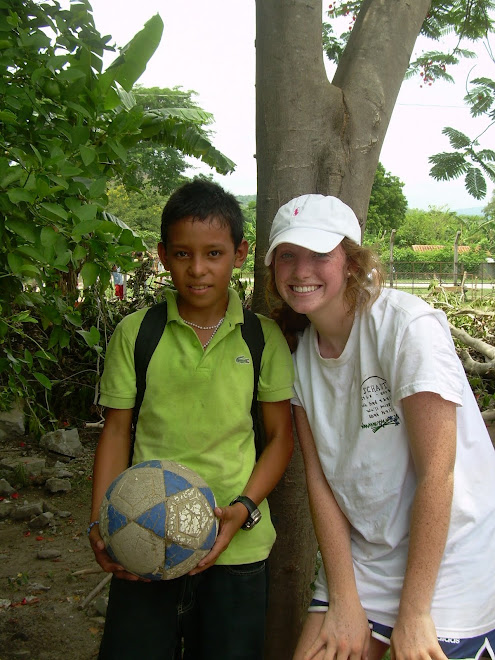
On my first day of work in the small town of Copapayo, El Salvador, I encountered a multitude of kind and welcoming faces. However, one in particular caught my attention. His name was Alexei. Alexei came to school everyday dressed in the same clothes as the day before, and the same broken sandals to attempt to protect his feet. Alexei and I first connected on the soccer field as we worked together as teammates to score on a goal made from two pieces of trash. We spent hours passing the soccer ball back and forth, dancing to Latino music, and eating tortillas quickly building a strong foundation of friendship. Of course our conversation consisted of no more than my few butchered attempts to say "Hola! Como estas?" followed by his returned looks of confusion and laughter, yet we still developed a tie of genuine bond.


On our last day of work in El Salvador, I said a sad good-bye to Alexei after the party we threw for the students at the school in Copapayo. About ten minutes later, I saw a familiar face wandering back to the worksite. It was Alexei again. After making friendship bracelets for one another out of some old yarn, we said a second round of farewells and parted ways. Yet after another hour, as our group began to board the bus to leave Copapayo, I looked up one last time. Alexei stood standing on that same soccer field where we had first met. Running up to me and planting a kiss on my cheek, he and I shared a tearful last "adios," for the third and final time. This bond between Alexei and me was a tie that would last forever. Though I knew I would never see his face again, he impacted me in many ways, and taught me the value of life comes not from material wealth, but from relationships and personal experiences.

As I arrived back at home the next week, I no longer found myself dwelling on the comforts of my own home as I had done early that morning of my departure, but instead found myself looking at those "comforts" of my own life with new eyes. Compared to the cardboard boxes I had seen families like Alexei's live in, my own house was a mansion. To their three daily tortillas, our refrigerator was overflowing. Coming back that third time to say good-bye, Alexei was my reminder of what genuine happiness looks like. Though Alexei and I were faced with cultural, lingual, and economic barriers, his passion and love of life inspired me to live a more wholesome life such as his. While I was a 16 year old girl with a closet full of shoes and a drawer full of shorts, this nine-year-old boy, with holes in his shoes and a single pair of shorts to wear for his every day, was never seen without a smile on his face, illuminating life's light.

In our world today, we are held to a certain standard of perfection, in which it is easy to forget the element of truth and substance in life. Embedded into the heart of the American consumer based society, we are told what clothes to wear, what food to eat, and how we should live, assuming the attainment of these things will result in happiness. In an endless chase for achievement and success, we find ourselves entangled in the materialistic web spun by society's spider, having lost sight of life's true meaning. Can we even begin to fathom life as Alexei, with hardly any money, a single outfit, and the same food everyday, and at the same time imagine happiness? After my cultural exchange and witness in Alexei, I found my eyes had been reopened to a new perspective on life.

Wednesday, December 9, 2009

Setting an Example

On November 27, a little over a week ago, Tiger Woods’ Escalade was found crashed in the middle of the night. It was later unveiled that he has multiple mistresses, and his wife had been using his own golf clubs violently against him hitting his car.

As Hollywood celebrities tend to frequently make bad impressions of themselves by their actions and poor decisions, it is always more frustrating to me to see professional athletes fall under this category. People all over the world, especially children and aspiring young adults, look to athletes as role models. Of course everyone sees celebrities as stunning and fascinating, but people find athletes to be inspirational and hard-working, as many times these athletes have come so far to stand where they are today. When outstanding Olympic Gold Medalist swimmer Michael Phelps was publicly displayed smoking marijuana, it ruined this image of a driven and unwavering young man, who put everything into his career, as most people saw him.

These athletes such as Tiger Woods and Michael Phelps are obviously famous worldwide. In their performance and lifestyle, they know that with fame comes publicity, as well as responsibility. Thousands of people look to them as powerful examples in life, yet they lead lives with drugs and sex scandals, and therefore ruin their reputations. It is an honor to achieve such a high recognition in life, and an honor to be admired so immensely. Therefore I think that professional athletes should be much more careful about the decisions they make and the lives they lead, as they are providing examples to so many.